Press Release Nr. 07/26 - repository search

Repository search becomes more specific

10/27/2026: The BGE significantly narrows down potential areas for final repository. Less than than 5% of Germany’s land area will be included in further considerations.

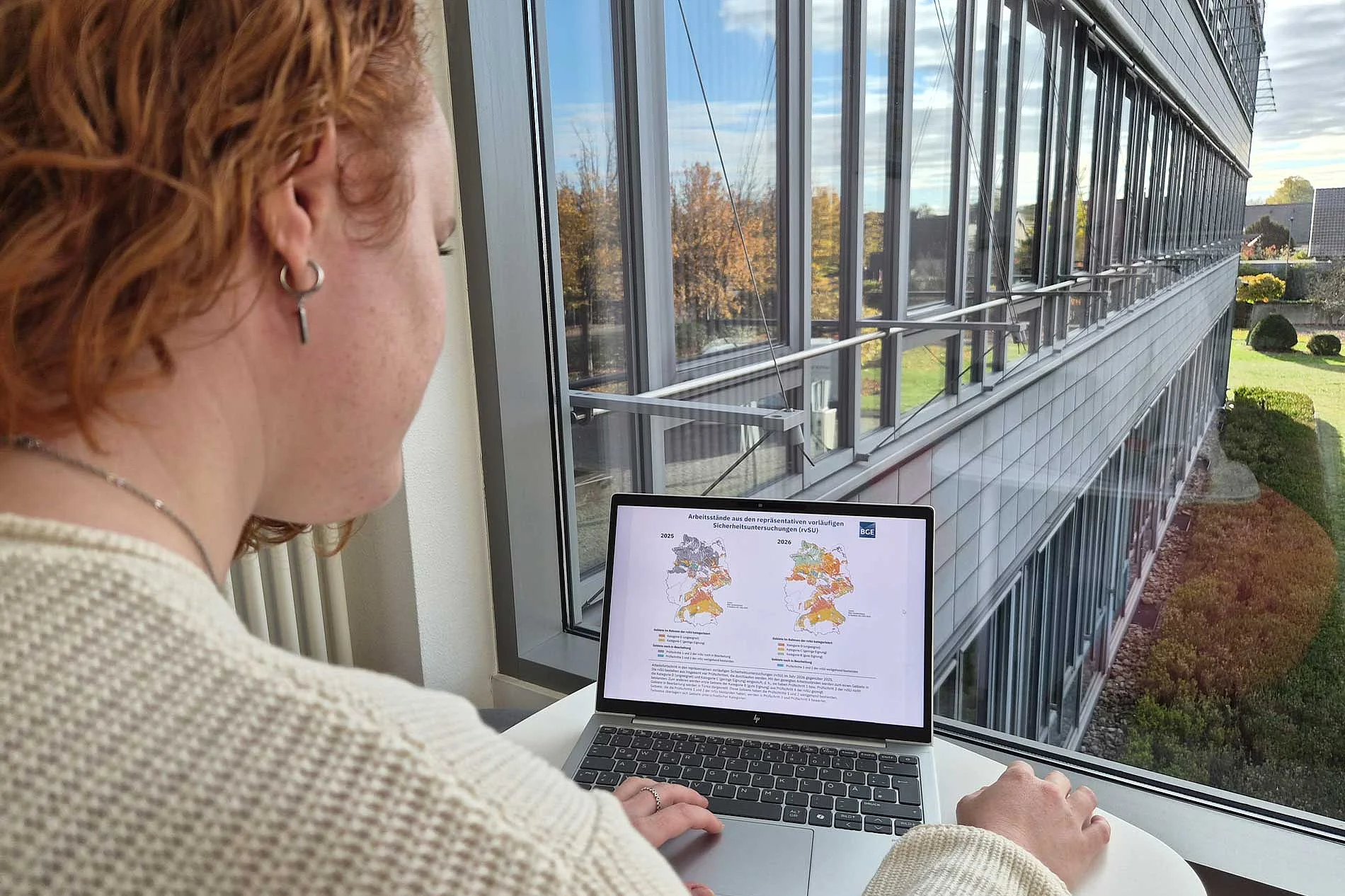
The Bundesgesellschaft für Endlagerung (BGE) is today publishing its final work status in relation to the repository search, before the siting regions for exploration are proposed at the end of next year. With the current work status update, the BGE is reducing the area that it is considering in the site selection procedure to less than 5% of the country’s territory. In 2025, around 25% of Germany’s land area was still in the running. The areas under further consideration are located in southern Germany, eastern Germany, and the north and north-west of Germany. The aim of the repository search is to identify the site providing the best possible safety for the final repository for Germany’s high-level radioactive waste. 

Iris Graffunder, Chair of the BGE Management Board, says: “With the progress made this year, the BGE is ensuring that the timetable for the highly complex, science-based repository search remains on track. We’ll continue to narrow down the areas until the end of 2027, until only a few potential siting regions remain in the running, which we’ll then propose for exploration. Today’s publication also ensures transparency at an early stage for people in Germany.”

To assess the host rocks, experts from the BGE analysed millions of geological datasets relating to Germany’s subsurface. “We’re confident that, through the ongoing site selection procedure, we’ll find an excellent site for high-level radioactive waste in Germany,” says Graffunder.

The BGE shows the latest work status in the BGE Repository Search Navigator. In this interactive map application, people can use the town and postcode search function to view the current work status in their region and access background information regarding categorisation. The areas that will not be included in further considerations as part of the site selection procedure are marked using a colour-coding system ranging from orange (unsuitable) through yellow (poorly suited) to pale green (suitable). Subsequent work will look only at the turquoise areas and will process them as part of further assessment steps. 
Graffunder says: “In the space of a year, our scientists have reduced the area that is still to be investigated – which accounted for around a quarter of the country’s total land area – to less than 5%. Step by step, the repository search is therefore becoming more specific.” 

Graffunder says: “In the space of a year, our scientists have reduced the area that is still to be investigated – which accounted for around a quarter of the country’s total land area – to less than 5%. Step by step, the repository search is therefore becoming more specific.”

At the end of 2027, the BGE will submit the proposed siting regions to the BASE.

The identification of potential siting regions for surface exploration is based on the 90 sub-areas published in 2020. In this process, the BGE assesses the sub-areas step by step as part of “representative preliminary safety analyses” (rvSU), using four assessment steps to evaluate the suitability of the sub-areas for the safe final disposal of high-level radioactive waste. As things stand, 36 sub-areas are still being investigated as part of these preliminary safety analyses. From the areas that perform best in the preliminary safety analysis, potential siting regions for surface exploration are identified using the geoscientific weighing criteria defined by law.

The BGE is working towards the next important stage in the process: at the end of 2027, it will submit the proposal for potential siting regions for surface exploration to the Federal Office for the Safety of Nuclear Waste Management (BASE) for review. On this basis, legislators will ultimately decide which siting regions then undergo surface exploration.