


FAQ about the repository search
Why do we need a repository? How long will the repository search take? Is there a way for members of the public to play an active part in the repository search? Who pays for the final disposal of high-level radioactive waste? How long must a repository remain safe? Why does nuclear waste have to be packed in special containers? On this page, we answer these and other questions regarding the site selection procedure for a repository for high-level radioactive waste.
If you have any further questions, please feel free to email us at dialog(at)bge.de.
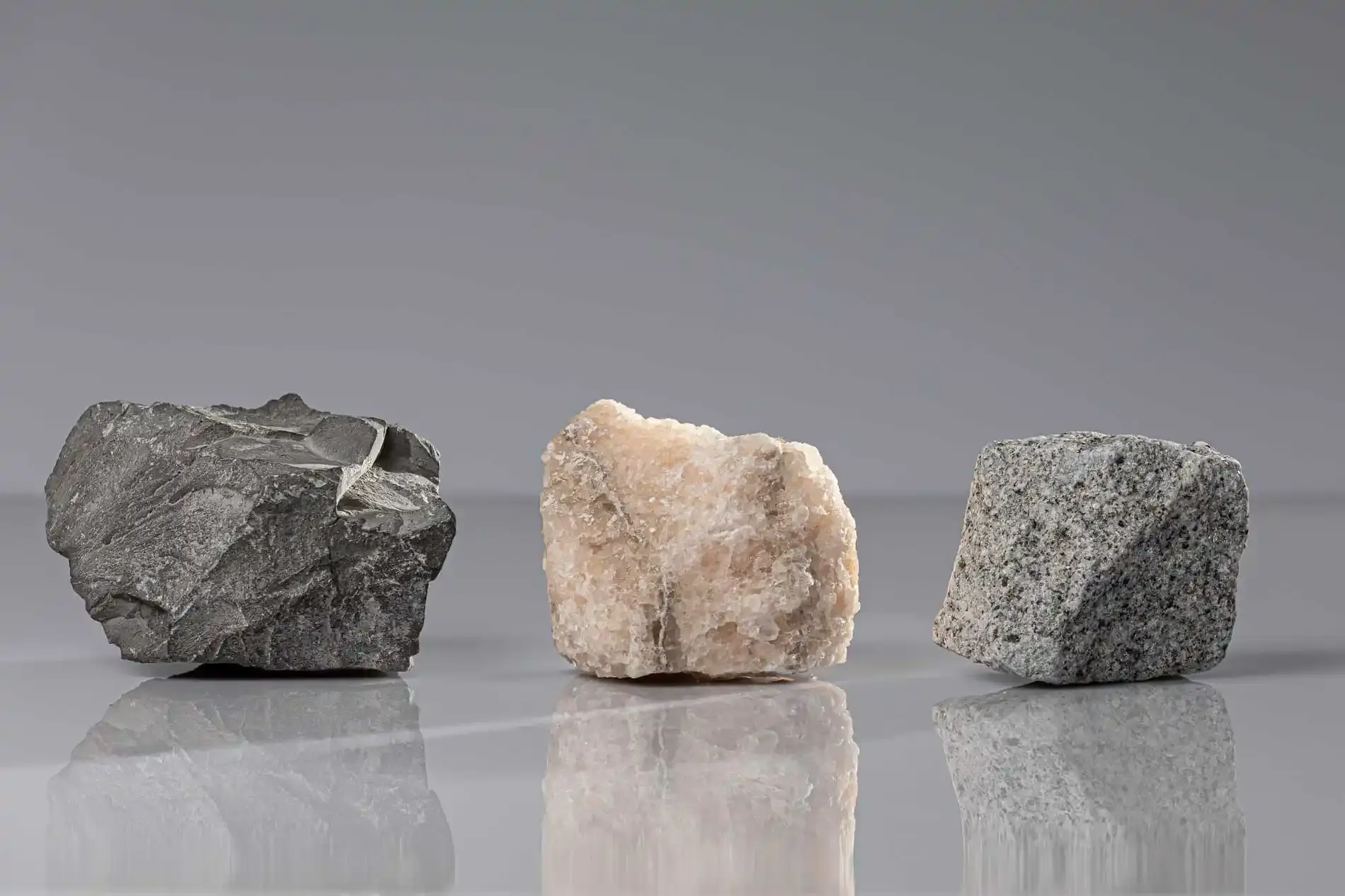
The three host rocks: clay rock, rock salt, crystalline rock
The search for a final repository is a legally regulated process for selecting the site with the highest possible level of security for high-level radioactive waste in deep geological formations in Germany. The process consists of three phases:
In Phase I, the Bundesgesellschaft für Endlagerung (BGE) will carry out a science-based assessment and comparison of the best geological zones in Germany with a view to proposing the best siting regions for further exploration on the basis of geological criteria. In the subsequent Phase II, the selected regions will be explored from the surface. In accordance with the Repository Site Selection Act (StandAG), underground investigations of selected sites are to be carried out in Phase III.
At the end of each phase, the BGE makes recommendations on how to proceed. These proposals are examined by the Federal Office for the Safety of Nuclear Waste Management (BASE). The BASE oversees the procedure and organises public participation. The aim is ultimately to identify the site in Germany that offers the highest possible level of safety, through a transparent, science-based process. In each instance, the Bundestag has the final say. At the end of each phase, it reviews the work of the BGE and decides on the next steps or the final location.
Last updated: March 2026
Related link
A repository is necessary to ensure safe and lasting protection of people and the environment from radioactive waste. Safe disposal is required by law and is the international standard approach. High-level radioactive waste, which results primarily from the operation of nuclear power plants, remains dangerous for hundreds of thousands of years. Surface interim storage facilities only offer temporary protection – whereas a deep geological repository guarantees long-term safety without relying on human intervention. This allows us to relieve the burden on future generations, who will no longer have to deal with the problem.
Last updated: March 2026
When looking for a repository, the thing that matters most is maximum safety – for a million years. To this end, research is underway in order to determine how effectively the rock in the subsurface can permanently contain the radioactivity of the waste. Other important factors include: the stability of the rock strata, no contact with groundwater, and no risk of volcanic activity. In addition, the repository must be technically feasible and able to be sealed securely. The procedure is governed by law and is carried out in stages, transparently and with public participation. Ultimately, the location is chosen with the greatest possible safety in mind.
Last updated: March 2026
Originally, the location was aimed to be determined by 2031. The Federal Ministry for the Environment, Climate Action, Nature Conservation and Nuclear Safety now expects the decision to be made by the middle of the century, after which the repository will still need to be approved and built. This period of time until the middle of the century is necessary in order to thoroughly assess geological safety, rule out risks and engage the public in the process. This is because the repository must safely contain radioactive waste for a million years. The procedure is regulated by law as a participatory, science-based, transparent, self-critical and learning-oriented process.
Last updated: March 2026
The search for a repository site for high-level radioactive waste in Germany is currently in the first of three phases of the statutory selection procedure. In 2020, the Bundesgesellschaft für Endlagerung (BGE) published an interim report identifying 90 sub-areas – areas where the geological conditions are expected to be suitable for the safe disposal of high-level radioactive waste. These sub-areas covered around 54% of Germany’s national territory. The BGE is currently working to further narrow down this shortlist and will propose specific siting regions for surface investigations by the end of 2027. Since the end of 2025, around 25% of the country’s territory has been under assessment to determine its suitability.
You can view the current status of the repository search in the BGE Endlagersuche Navigator. Please note that the BGE shows information on the progress of work here, not definitive results.
Last updated: March 2026
Even if several regions are initially examined, there will ultimately only be one repository for high-level radioactive waste in Germany. The aim is to find a site that offers the highest possible level of safety for one million years – regardless of political, economic or regional interests. The site must meet all statutory requirements and provide long-term safety. The decision will be made by parliament through legislation. A central repository is also in line with international recommendations and forms part of a responsible waste management policy. In addition, there will be two further repositories: the Konrad repository for low- and intermediate-level radioactive waste (with low heat generation) and another repository for low- and intermediate-level radioactive waste that cannot be stored at the Konrad repository because the facility is only authorised for 303,000 cubic metres of waste.
Last updated: March 2026
It is not yet clear which regions in Germany are suitable for a repository. In 2020, the Bundesgesellschaft für Endlagerung (BGE) identified, in its Sub-areas Interim Report (PDF, 25,57MB), 90 sub-areas where the geological conditions in the deep subsurface could allow safe containment – this corresponds to around 54% of the national territory. These areas are situated in various federal states and comprise the three host rocks claystone, salt rock and crystalline rock. In the next phases of the repository search, the BGE will further narrow down this selection until, ultimately, at least two sites remain. The year 2027 marks a very significant step in this process, as it is the year in which the BGE will propose specific siting regions for surface investigation. There is no predetermined focus on specific regions – the search is being conducted in an open-ended and science-based manner.
Last updated: March 2026
Yes, the Repository Site Selection Act sets out clear exclusion criteria. For example, areas are excluded if they have active geological faults, volcanic activity or human intervention such as mining or boreholes. All of these factors could compromise the safety of the repository. In addition, the Bundesgesellschaft für Endlagerung (BGE) assesses minimum requirements such as the depth and thickness of the rock. Only areas that meet these criteria are eligible for further investigation.
Last updated: March 2026
Yes, members of the public can play an active part in the repository search. The Repository Site Selection Act requires extensive public participation. Various stages of the process include specialist conferences, the Forum on the Repository Search (Forum Endlagersuche), regional conferences, online dialogues and consultation procedures. Regions that make it onto the shortlist will be offered further opportunities for participation. The Federal Office for the Safety of Nuclear Waste Management (BASE) is responsible for public participation, with a view to ensuring that the process is transparent, comprehensible and conducted in dialogue with the public. This enables all citizens to provide information, ask questions or raise concerns. If you would like to get involved or have any further questions about participation, please feel free to contact dialog(at)base.bund.de.
Last updated: March 2026
A federal state or region cannot unilaterally prevent a repository from being established within its territory. Site selection is a legally regulated, nationwide procedure. It is based on scientific criteria and is not dependent on political majorities in individual federal states. Ultimately, the Bundestag will decide on the location through legislation. However, federal states, local authorities and members of the public have the opportunity to play an active role in the process – e.g. through statements, conferences and participatory formats. In this way, regional perspectives are taken into account. The aim is to reach a transparent decision regarding the site with the highest possible level of safety – in the interests of society as a whole. The regions concerned and their residents can have the Federal Administrative Court review whether everything was done properly.
Last updated: March 2026
The National Citizens’ Oversight Committee (NBG) is an independent body that acts as a mediator in the search for a repository. Its main task is to monitor the site selection procedure, strengthen public participation and act as a mediator between society, the political sphere and the institutions involved in the procedure.
The NBG has 18 members, 12 of which are recognised figures from public life, who are appointed by the Bundestag and Bundesrat. The other six members are members of the public, two of whom are from the younger generation. The six citizens are selected through a multi-stage participatory process and subsequently appointed by the Federal Minister for the Environment.
The NBG is neither bound by directives nor part of the administrative structure – it operates independently and in the public interest. It may at any time obtain information from the institutions involved, inspect files and seek expert advice from third parties. In this way, the National Citizens’ Oversight Committee helps to ensure that the process is transparent, comprehensible and conducted in the interests of society as a whole.
Last updated: March 2026
Those responsible for generating radioactive waste are responsible for funding the final disposal – that is, the operators of nuclear power plants. To this end, a fund (KENFO) was set up in 2017, into which the operators paid around 24 billion euros. The federal government uses this money to fund the final disposal of high-level radioactive waste and, in part, the construction, operation and decommissioning of the Konrad repository. The fund is set up on a long-term basis so that future costs are also covered. The former operators of nuclear power plants continue to be responsible for financing the dismantling of their facilities (such as nuclear power plants) and for the safe containment of radioactive waste.
Last updated: March 2026
Worldwide, disposal in deep geological formations is regarded as the safest method of permanently isolating high-level radioactive waste from humans and the environment. Several barriers – including special containers, the host rock and, in some cases, engineered seals – reliably prevent the escape of radioactive substances. In most repository concepts, the host rock is the most important barrier. The site must also offer particularly stable geological conditions over very long periods of time. Before a repository is built, experts carry out an intensive review of all safety aspects.
Last updated: March 2026
A repository must remain safe over an extremely long period of time – at least one million years for high-level radioactive waste. During this period, the radioactivity of the waste gradually decreases until it ultimately reaches a level comparable to the natural radioactivity of the surrounding environment. To ensure safety over such long periods of time, the BGE looks for rock formations that have remained virtually unchanged over millions of years. The repository itself is also designed in such a way that it requires no further maintenance or intervention – this is referred to as a passive safety system. The safety cases must meet the highest scientific and legal standards.
Last updated: March 2026
The transport and storage of nuclear waste must not pose any risk to humans or the environment. Suitable disposal containers can shield against the radiation emitted by radioactive waste and prevent unauthorised releases, even in the event of an accident. High-level radioactive waste is placed in specialised, technically sophisticated and costly containers for transport and interim storage. Known as casks for storage and transport of radioactive material (CASTORs), these thick-walled containers also shield against strong radiation and dissipate heat. They feature a sealed double-lid system and are also particularly shock- and pressure-resistant so that they can provide safety even in the event of accidents or natural disasters. A loaded CASTOR weighs between 20 and 120 tonnes, depending on the type of container and its contents.
Last updated: March 2026
Related Links
CASTORs are transport and storage containers originally designed for a period of interim storage of 40 years – calculated from the time of filling with high-level radioactive waste. They are not intended for disposal. However, that does not mean they are no longer safe after 40 years. Before the 40-year period expires, a licensing procedure will determine whether the containers are eligible for an extension of their licence. In doing so, the inspectors take account not only of the condition of the container but also of whether it and all its components still comply with current technical standards. The CASTORs are currently stored in interim storage facilities. Most such facilities are operated by BGZ Gesellschaft für Zwischenlagerung. The Federal Office for the Safety of Nuclear Waste Management (BASE) is responsible for supervising BGZ. As part of the licensing procedure, the BASE also decides on the continued storage of the CASTORs at the interim storage facility.
The BGE is currently developing new containers for the future repository – known as disposal containers. The high-level radioactive waste will be transferred to these containers before being stored in the repository. You can find a recording of an event on this subject from 2024 here: Development of repository containers (external link)
Last updated: March 2026
A repository is built in such a way that it remains secure even in exceptional circumstances such as sabotage or terrorist attacks. The waste is emplaced deep underground – several hundred metres below the surface – where it is protected by the host rock. In addition, the repository is subject to strict safety standards, as are other nuclear facilities. Safety is continuously reviewed and adapted in line with new findings.
Last updated: March 2026
The Repository Site Selection Act does not specify a minimum distance from settlements. First and foremost, it is vital that the repository be safely located deep underground. In other words, it must be ensured that radioactive materials cannot reach the surface or enter the environment over very long periods of time – regardless of whether people live nearby or not. Geological conditions are therefore a key consideration in the repository search. Nevertheless, proximity to residential areas is a relevant factor and is taken into account in supplementary selection criteria and other statutory provisions.
Last updated: March 2026
The fuel rods used in a nuclear power plant must first be left to cool in the plant’s spent fuel pool for around five years, as they continue to generate a great deal of heat during this period due to the high quantity of short-lived fission products. They are then packed into transport and storage containers, which are generally CASTORs in Germany. These casks are being stored in interim storage facilities (usually on the sites of former nuclear power plants) until a repository for high-level radioactive waste is completed. Only then will the CASTORs be transported. Most of this transport will take place by rail on special container wagons. CASTORs are only transported by road in areas where there is no rail infrastructure. Once the high-level radioactive waste has arrived at the repository site, it will be transferred into disposal containers. The disposal containers are yet to be developed by the BGE.
Last updated: March 2026
With regard to high-level radioactive waste, the Repository Site Selection Act stipulates that it must be possible to retrieve waste that has already been emplaced. The law makes a distinction between retrieval and recovery. As long as the repository mine is in operation and has not yet been completely sealed, the waste must be retrievable. It must then remain recoverable for a further 500 years. This ensures that action can be taken in the event of new findings or unforeseen events.
Last updated: March 2026