


FAQ about nuclear waste
What is the difference between low-, medium-, and high-level radioactive waste? How much nuclear waste is there? And why does nuclear waste need to be placed in a repository? You’ll find answers to these and other questions on this page.
We regularly receive questions from citizens on this topic. We’re compiling the answers in an ever-growing collection.
If you have any further questions, please feel free to email us at dialog(at)bge.de.
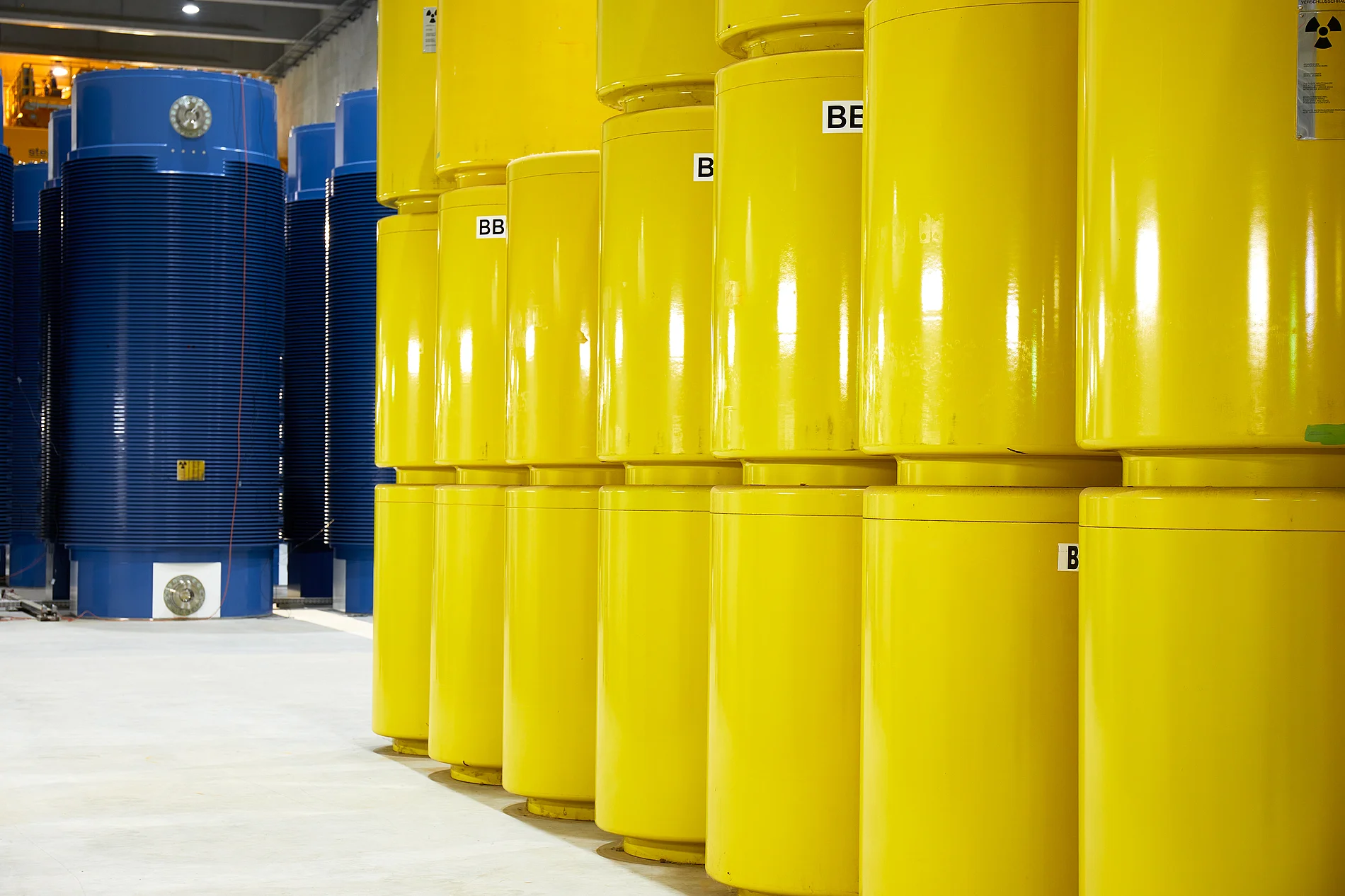
Radioactive waste at the Biblis interim storage facility. Source: ©BGZ/Mick
A distinction is made between high-level radioactive waste and low- and intermediate-level radioactive waste. High-level radioactive waste originates primarily from nuclear power plants, either in the form of spent fuel elements or as vitrified waste resulting from their reprocessing. It gives off a strong glow and generates heat. Low- and intermediate-level radioactive waste is produced, for example, during the dismantling of nuclear facilities such as nuclear power plants. Examples of radioactive waste include contaminated or activated plant components, ventilation ducts and construction waste, as well as protective clothing and cleaning materials. Low- and intermediate-level radioactive waste is also generated in research centres and in healthcare. The level of radioactivity is a key factor in determining how the waste is handled and packaged. Low- and intermediate-level radioactive waste is easier to handle than high-level radioactive waste. However, there is a significantly greater quantity of low- and intermediate-level radioactive waste, which makes it challenging in a different way.
Last updated: March 2026
Related Links
How much nuclear waste is there?
Even though the nuclear power plants have long since been shut down, radioactive waste will continue to be a concern for a long time to come. Experts from the German government expect the following quantities by 2080: High-level radioactive waste will account for around 27,000 cubic metres. Although it accounts for less than 5% of the total volume of nuclear waste, it contains around 99% of the total radioactivity of all such waste. The volume of low- and intermediate-level radioactive waste is estimated to be up to 660,000 cubic metres following its conditioning, i.e. its packaging for interim or final disposal. This waste is made up as follows: 360,000 cubic metres of waste originate from the operation and dismantling of publicly owned nuclear power plants and nuclear facilities, as well as from industry, research and medicine. 200,000 cubic metres consist of waste retrieved from the Asse II mine, and 100,000 cubic metres are residues from uranium enrichment.
Last updated: March 2026
Nuclear waste contains radioactive substances with an unstable atomic nucleus. When this nucleus decays, radiation is released. Although humans are unable to perceive this ionising radiation, it is so high in energy that it can damage genetic material, cells, tissues and organs. This can lead to a greater risk of cancer. There are different types of ionising radiation – namely alpha, beta and gamma radiation. Alpha radiation penetrates only a fraction of a millimetre into the skin. Beta radiation penetrates slightly deeper, a few millimetres, into the body. These types of radiation are particularly harmful to health when they are absorbed into the body via inhalation or food. Gamma radiation, on the other hand, can penetrate the entire body. The danger posed by radiation depends on the dose, the type of radiation and the length of time the body is exposed to it. This, in turn, determines how dangerous the nuclear waste is.
Last updated: March 2026
Nuclear waste contains many different radioactive substances, such as caesium-137, iodine-129 and uranium-235. The time for which these substances emit radiation depends on their half-life. This is the time it takes for half of the unstable atomic nuclei – also known as radionuclides – to decay. The half-lives of radioactive substances range from a few seconds to billions of years. Long half-lives are not the same as high radiation intensity. For example, fresh nuclear fuel (alpha emitters) emits virtually no measurable radiation. It is only when the nuclear fuel is used in the reactor that fission takes place, resulting in the formation of many shorter-lived radionuclides, known as fission products. These products are generally responsible for the high radiation intensity of high-level radioactive waste. Low- and intermediate-level radioactive waste may contain both short-lived and long-lived radionuclides, albeit in lower concentrations.
If waste contains only very short-lived radionuclides, it may be excluded from the scope of the Atomic Energy Act or the Radiation Protection Act following what is known as “decay storage” and subsequent clearance measurements. This is then referred to as clearance or decay-storage waste.
Last updated: March 2026
The safe disposal of nuclear waste in suitable host rock deep underground is intended to ensure that people and nature are protected from the dangerous effects of radiation. A deep repository shields radiation, confines radioactive materials for the long term and also prevents the contamination of soil and groundwater. Furthermore, it protects future generations from accidental contact with the radioactive waste. Unlike buildings on the surface, geology has already shown that it can remain stable over millions of years. Once sealed, a repository does not require continuous monitoring.
Last updated: March 2026
To date, there is still no way of rendering nuclear waste harmless. The transmutation process, which is intended to convert highly radioactive nuclear waste into less hazardous substances using special reactors, requires complex nuclear facilities with the corresponding risks. Furthermore, the fission process in turn produces radioactive substances – known as fission products – which, in the worst-case scenario, may spread onto other surfaces or liquids due to the process, leading to the generation of new radioactive waste. Furthermore, radioactivity remains in the transmuted material itself, meaning that final disposal will always be necessary, even with transmutation.
Simply launching nuclear waste into space would be far too risky. After all, what would happen if a rocket launch were to fail? In the past, nuclear waste was also dumped at sea. That practice is now prohibited. There is far too great a risk of the containers rusting in the water and the radioactive substances dispersing into the sea. Storing the waste permanently on the earth’s surface or at a shallow depth is also not a safe option in the long term. It is only at a depth of several hundred metres that the naturally occurring rock forms a barrier that offers protection without the need for ongoing human maintenance.
Last updated: March 2026
Package quality assurance ensures that low- and intermediate-level radioactive waste is correctly described – declared – and safely packaged before it goes to the Konrad repository. To this end, the BGE also commissions independent expert bodies to check the documentation relating to the waste and its packaging, as well as to carry out spot checks on the waste itself. Lastly, the BGE’s experts check the completeness and plausibility of the reports from the expert bodies. Ultimately, they certify the waste package and clear it for final disposal.
Last updated: March 2026